
Developing Leadership Capacity
The Lundy Foundation—Our Core Competencies
If your actions inspire others to dream more, learn more, do more, and become more, you are a leader.
John Quincy Adams, sixth President of the United States
Our expertise is to optimize human potential within the humanitarian ecosystem by supporting the professional growth of exemplary leaders, and to provide the tools and training to build and maintain high-performing teams.
The Lundy Foundation helps build leadership capacity in individuals, organizations, and communities seeking a voice in political, social, and community affairs. Using custom-designed training programs and assessments, we facilitate the development of collaborative leadership, alliances, and networks among individuals and organizations seeking to initiate sustainable social progress. Our training programs:
- Establish a structure for building effective and sustainable leadership capacity
- Focus on helping individuals, organizations, and communities identify problems, prioritize potential solutions, and implement effective action plans
- Provide a forum for exploring the challenges faced by individuals, organizations, and communities as they seek to develop practical skills and leadership practices that are ethical and sustainable
We design and deliver innovative training curriculums implemented by a team of prominent experts in the fields of leadership development, community-building, and collaborative decision-making.
Characteristics of Transformational Leadership
The Lundy Foundation believes that the kind of leadership needed today and in the future is not inborn, inherited, elected, or even taught. The great leaders of today and tomorrow embody a combination of emotional and intellectual traits, acquired skills, humanitarian values, integrity, and humility. Inspiring leaders:
- Foster credibility and transparency
- Lead strong, equitable decision-making processes
- Involve other high-level, visible leaders
- Engage and build networks of key stakeholders
- Overcome mistrust and skepticism with transparency
- Work effectively with established authorities and powers
- Avoid micro-management by focusing on broader concerns
- Address conflict directly and effectively
- Offer and receive constructive feedback
- Use power constructively—always
- Explore the shadow side of leadership, to include assessing and appreciating the humanness of self and others, focusing inwardly, examining internal defenses and coping mechanisms and other behaviors that can limit an individual’s effectiveness as a leader
Characteristics of High-Performing Teams
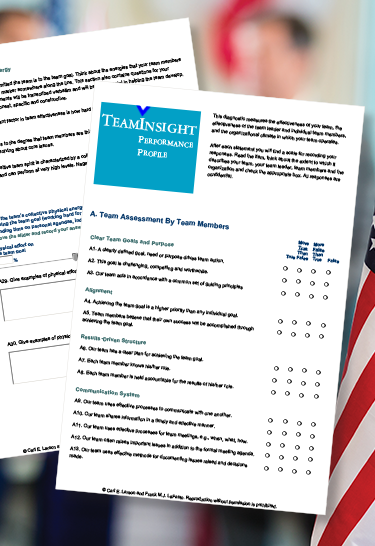
The Lundy Foundation’s work in building high-performing teams is based on research conducted by Carl E. Larson and Frank M.J. LaFasto on 800 private and nonprofit teams, including executive management, cardiac surgery, professional sports, military and Antarctic expedition teams. They identified eight key success indicators of high-performing teams:
- A clear goal that is elevating and measurable
- A results-driven structure, with clear lines of accountability and communication
- Competent team members equipped for and aligned with performance objectives
- Unified commitment, focusing individual effort toward to the team’s objective, not individual recognition
- A collaborative climate characterized by trust, honesty, openness, consistency, respect, and support
- Standards of excellence that require outstanding performance, not just adequate work
- External support and recognition by outside groups and institutions that value performance, support the team with resources, and reward success
- Principled leadership that provides a vision, makes course corrections as needed to make the vision a reality, and motivates team members to unleash their energy and talent